Design Patterns
Notes and exercises for learning design patterns
Command Design Pattern
1. What problem are we trying to solve?
You’re building a simple text editor. You write this:
class Document:
    def __init__(self):
        self.content = ""

    def insert(self, text: str, position: int) -> None:
        self.content = self.content[:position] + text + self.content[position:]

    def delete(self, position: int, length: int) -> None:
        self.content = self.content[:position] + self.content[position + length:]
It works. Then the product manager says: “Add undo.”
Your first instinct is to add an undo() method to the document. But undo what? The document has to remember what just happened and how to reverse it. So you add a history log inside the document.
Then: “Add redo.” Now you need a redo stack too. The document is growing into a mess that mixes “storing text” with “remembering operations” with “reversing operations.”
Then: “Let users record macros — sequences of actions they can replay.” The editor now has to know which actions were taken, in what order, so it can replay them. The document can’t possibly own this.
Then: “Add a toolbar button and a keyboard shortcut that both trigger the same insert action.” Now two different pieces of UI both need to know how to call document.insert(...) with the right arguments. You end up duplicating the call in two places, and they can drift.
The core tension is:
The thing that decides to do an action and the thing that knows how to do it shouldn’t be the same object. And the action itself should be something you can store, pass around, undo, and replay.
That’s the problem the Command pattern solves.
2. Concept introduction
The Command pattern turns an action into an object.
Instead of directly calling document.insert("hello", 0), you create an object that represents that call — its target, its method, its arguments — and hand it to something else to execute.
Before:  Button → document.insert("hello", 0)
After:   Button → InsertCommand("hello", 0) → execute() → document.insert("hello", 0)
In plain English:
A Command wraps “do this thing” into a first-class object that can be stored, queued, logged, undone, or replayed — by anyone, at any time.
Command is a behavioral pattern. Behavioral patterns are about how objects communicate and who is responsible for what. Command answers:
How do I decouple the thing that triggers an action from the thing that performs it, while gaining the ability to track, undo, and compose actions?
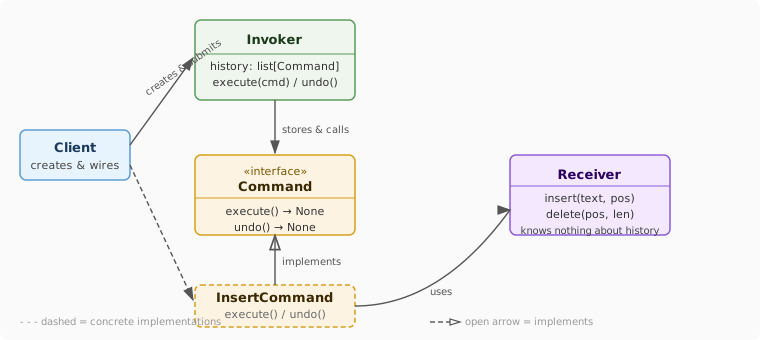
The four roles:
| Role | Responsibility |
|---|---|
| Command | Encapsulates one action — knows execute() and undo() |
| Receiver | The object that actually does the work (e.g., Document) |
| Invoker | Triggers commands without knowing what they do (e.g., toolbar, scheduler) |
| Client | Creates the command objects and wires them to the invoker |
3. The minimal structure
from abc import ABC, abstractmethod

class Command(ABC):
    @abstractmethod
    def execute(self) -> None: ...

    @abstractmethod
    def undo(self) -> None: ...
That’s the entire interface. One method to do, one to reverse. Everything else is a concrete command that implements it.
class Document:
    def __init__(self):
        self.content = ""

    def insert(self, text: str, position: int) -> None:
        self.content = self.content[:position] + text + self.content[position:]

    def delete(self, position: int, length: int) -> None:
        self.content = self.content[:position] + self.content[position + length:]


class InsertCommand(Command):
    def __init__(self, document: Document, text: str, position: int):
        self._document = document
        self._text = text
        self._position = position

    def execute(self) -> None:
        self._document.insert(self._text, self._position)

    def undo(self) -> None:
        self._document.delete(self._position, len(self._text))


class DeleteCommand(Command):
    def __init__(self, document: Document, position: int, length: int):
        self._document = document
        self._position = position
        self._length = length
        self._deleted_text = ""  # captured on execute, needed for undo

    def execute(self) -> None:
        self._deleted_text = self._document.content[self._position:self._position + self._length]
        self._document.delete(self._position, self._length)

    def undo(self) -> None:
        self._document.insert(self._deleted_text, self._position)
Note that DeleteCommand captures the deleted text on execute(). This is a key detail: commands must be self-contained — undo() can’t take arguments; it must carry everything it needs to reverse itself from the moment it was executed.
4. The Invoker — where the history lives
The invoker holds the history stacks. It knows nothing about documents, text, or positions — it just executes commands and remembers them.
class CommandHistory:
    def __init__(self):
        self._history: list[Command] = []
        self._redo_stack: list[Command] = []

    def execute(self, command: Command) -> None:
        command.execute()
        self._history.append(command)
        self._redo_stack.clear()   # a new action invalidates the redo future

    def undo(self) -> None:
        if not self._history:
            return
        command = self._history.pop()
        command.undo()
        self._redo_stack.append(command)

    def redo(self) -> None:
        if not self._redo_stack:
            return
        command = self._redo_stack.pop()
        command.execute()
        self._history.append(command)
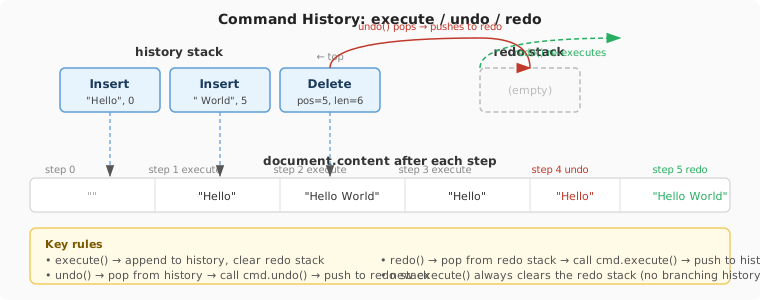
Now the client code is clean:
doc = Document()
history = CommandHistory()

history.execute(InsertCommand(doc, "Hello", 0))
print(doc.content)   # "Hello"

history.execute(InsertCommand(doc, " World", 5))
print(doc.content)   # "Hello World"

history.undo()
print(doc.content)   # "Hello"

history.redo()
print(doc.content)   # "Hello World"
The document knows nothing about history. The history knows nothing about text. The commands bridge them.
5. Natural example: a bank account
This is the most natural fit for Command because financial systems literally work this way — every action is a recorded transaction that can be audited.
from abc import ABC, abstractmethod
from dataclasses import dataclass, field
from datetime import datetime


class Command(ABC):
    @abstractmethod
    def execute(self) -> None: ...

    @abstractmethod
    def undo(self) -> None: ...


class BankAccount:
    def __init__(self, owner: str, balance: float = 0.0):
        self.owner = owner
        self._balance = balance

    def deposit(self, amount: float) -> None:
        self._balance += amount

    def withdraw(self, amount: float) -> None:
        if amount > self._balance:
            raise ValueError(f"Insufficient funds: have {self._balance}, need {amount}")
        self._balance -= amount

    @property
    def balance(self) -> float:
        return self._balance

    def __str__(self):
        return f"{self.owner}: ${self._balance:.2f}"


class DepositCommand(Command):
    def __init__(self, account: BankAccount, amount: float):
        self._account = account
        self._amount = amount

    def execute(self) -> None:
        self._account.deposit(self._amount)

    def undo(self) -> None:
        self._account.withdraw(self._amount)


class WithdrawCommand(Command):
    def __init__(self, account: BankAccount, amount: float):
        self._account = account
        self._amount = amount
        self._success = False

    def execute(self) -> None:
        self._account.withdraw(self._amount)
        self._success = True

    def undo(self) -> None:
        if self._success:
            self._account.deposit(self._amount)


@dataclass
class AuditedCommandHistory:
    _history: list[tuple[Command, datetime]] = field(default_factory=list)
    _redo_stack: list[Command] = field(default_factory=list)

    def execute(self, command: Command) -> None:
        command.execute()
        self._history.append((command, datetime.now()))
        self._redo_stack.clear()

    def undo(self) -> None:
        if not self._history:
            return
        command, _ = self._history.pop()
        command.undo()
        self._redo_stack.append(command)

    def print_log(self) -> None:
        for cmd, ts in self._history:
            print(f"  [{ts:%H:%M:%S}] {cmd.__class__.__name__}")


# Usage
account = BankAccount("Alice", balance=1000.0)
ledger = AuditedCommandHistory()

ledger.execute(DepositCommand(account, 500))
ledger.execute(WithdrawCommand(account, 200))
print(account)          # Alice: $1300.00

ledger.undo()
print(account)          # Alice: $1500.00 — withdrawal reversed

ledger.print_log()
# [14:03:01] DepositCommand
Every action is recorded. You can audit, undo, and extend without touching BankAccount at all.
6. Connection to earlier patterns and SOLID
What SOLID principles were being broken before
Without Command, callers hold direct references to the receiver and know its full API. Multiple callers duplicate the same calls. Adding a new action requires touching every caller — a clear OCP violation at the orchestration layer.
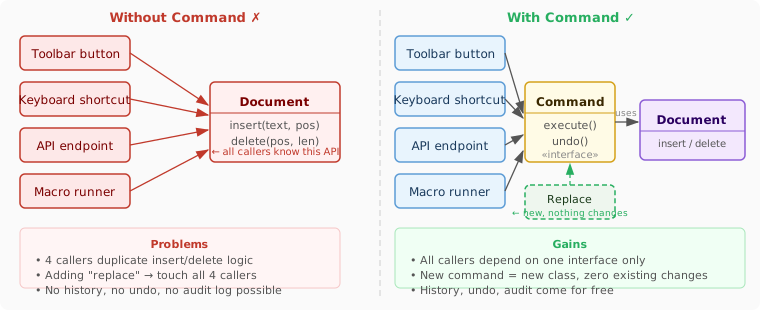
The precise OCP claim: Command gives you OCP over the invoker and the callers. When you add ReplaceCommand, it composes existing primitives (delete + insert) — nothing existing changes. The only time Document grows is when you need a genuinely new low-level primitive that doesn’t exist yet (e.g., format_bold()). That’s the receiver gaining a new capability, not an OCP violation in the Command infrastructure.
| SOLID principle | Without Command | With Command |
|---|---|---|
| SRP ✗ | Document mixes text storage + history + undo logic | Each class has one job |
| OCP ✗ | Every new action requires touching all callers | New action = new class only |
| DIP ✗ | Toolbar depends directly on Document |
All callers depend on Command abstraction |
Connection to earlier patterns
Composite — A sequence of commands (a macro) can itself implement Command. That’s the Composite Command, which is the next pattern. The invoker treats a macro and a single command identically.
Memento — An alternative approach to undo. Instead of each command knowing how to reverse itself, Memento saves a full snapshot of the receiver’s state before each command. Command-with-undo is leaner; Memento is more robust when reversals are hard to compute (e.g., image filters).
Chain of Responsibility (CQS) — The command’s execute() is a pure command in the CQS sense (returns nothing, changes state). Its undo() is also a command. The clean CQS split is what makes commands composable and their history traceable.
Strategy — Both encapsulate behavior as objects. The difference: Strategy swaps how something is done right now. Command records what was done so it can be stored, queued, and undone later.
7. Example from a popular Python package: SQLAlchemy
SQLAlchemy’s Unit of Work (the Session) uses Command-like queueing. Every ORM operation (session.add(), session.delete()) queues up a pending change internally. Nothing hits the database until session.commit() — at which point the session flushes the command queue in the correct dependency order.
from sqlalchemy.orm import Session

with Session(engine) as session:
    session.add(new_user)       # queued, not executed
    session.add(new_profile)    # queued
    session.commit()            # invoker flushes all commands to the DB
    # session.rollback()        # invoker discards the entire queue
session.commit() is the invoker’s execute(). session.rollback() is the invoker’s undo(). The session doesn’t care what the commands are — it just knows they support flush and rollback.
unittest.mock also records every call as a command-like object in call_args_list, letting you assert or replay calls after the fact:
from unittest.mock import MagicMock

service = MagicMock()
service.send_email("alice@example.com", "Hello")
service.send_email("bob@example.com", "Hi there")

print(service.send_email.call_args_list)
# [call('alice@example.com', 'Hello'), call('bob@example.com', 'Hi there')]
8. When to use and when not to use
Use Command when:
| Situation | Why Command helps |
|---|---|
| You need undo/redo | Commands carry their own reversal logic |
| You need to queue or schedule operations | Commands are objects — put them in a queue |
| You need an audit log | Store commands with timestamps |
| Multiple triggers invoke the same action | All share one command class |
| You want to compose actions into macros | Commands compose into Composite Commands |
| You need transactional behaviour | Roll back by calling undo() on queued commands |
Do not use Command when:
- Actions are simple, one-off, and never need to be tracked or reversed — a direct method call is clearer.
- The overhead of one class per action is disproportionate to the benefit (e.g., a tiny CLI script).
- You’re in a functional context —
functools.partialor closures may be sufficient. - There’s no clear receiver — you’d just be wrapping a free function with boilerplate.
9. Practical rule of thumb
If you ever find yourself writing
last_action = "insert"andlast_args = (...)to remember what just happened so you can undo it — stop. That is a hand-rolled Command object. Make it a real one.
Also:
Every concrete command should capture everything it needs at construction time.
execute()andundo()must take no arguments. If they do, the command isn’t self-contained and can’t be replayed safely.
The simplest structural test:
command = SomeCommand(receiver, arg1, arg2)
command.execute()    # takes no arguments
command.undo()       # takes no arguments
If you’re passing arguments to execute(), you haven’t moved the knowledge into the command yet.
10. Summary and mental model
The Command pattern turns method calls into objects.
Without Command:   caller → receiver.action(args)       ← ephemeral, gone immediately

With Command:      caller → Command(receiver, args)
                                 │
                             stored in history
                                 │
                          execute() → receiver.action(args)
                          undo()    → receiver.reverse(args)
Mental model — think of a written work order:
Without Command:   you walk up to the mechanic and say "change the oil"
                   it happens immediately, there's no record, it can't be undone

With Command:      you write a work order: "change oil on car #42, bay 3, 9am"
                   the work order can be:
                     stored and filed          (audit log)
                     handed to any mechanic    (decoupled from who executes it)
                     cancelled before done     (undo)
                     scheduled for later       (queue)
                     bundled into a service    (composite command / macro)
The work order is the command. The mechanic is the receiver. The service desk is the invoker.
| Concept | Role |
|---|---|
Command interface |
Guarantees execute() and undo() exist |
| Concrete command | Captures one action + its receiver + its args |
| Receiver | Does the real work, knows nothing about history |
| Invoker | Stores and fires commands, owns the history stacks |
| Client | Creates and wires commands to the invoker |
In one sentence:
The Command pattern wraps a method call into an object so it can be stored, queued, logged, undone, or replayed — decoupling who triggers an action from who performs it.