Design Patterns
Notes and exercises for learning design patterns
Transparent Decorator (Dynamic Proxy)
1. What problem are we trying to solve?
The standard Decorator pattern works cleanly when you only ever call methods declared on the shared interface. But real objects have richer APIs than what any interface captures.
Suppose you are building a reporting system. You have a ReportWriter that writes reports, and you want to add logging around it:
from abc import ABC, abstractmethod


class Writer(ABC):
    @abstractmethod
    def write(self, content: str) -> None:
        pass


class ReportWriter(Writer):
    def write(self, content: str) -> None:
        print(f"Writing: {content}")

    def set_encoding(self, encoding: str) -> None:
        self._encoding = encoding

    def get_page_count(self) -> int:
        return 12

    def flush(self) -> None:
        print("Flushing buffer")


class LoggingDecorator(Writer):
    def __init__(self, wrapped: Writer):
        self._wrapped = wrapped

    def write(self, content: str) -> None:
        print(f"LOG: writing {len(content)} chars")
        self._wrapped.write(content)
Now the caller pays a tax for decoration:
writer = LoggingDecorator(ReportWriter())

writer.write("Annual Report")    # works
writer.set_encoding("utf-8")     # AttributeError
writer.get_page_count()          # AttributeError
writer.flush()                   # AttributeError
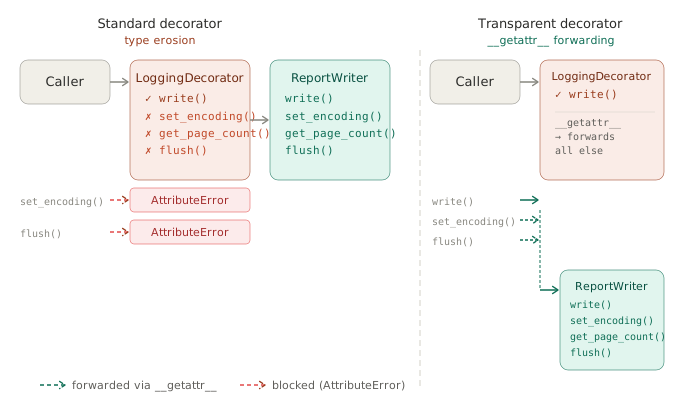
The moment you wrap ReportWriter, you lose set_encoding, get_page_count, and flush. The decorator knows nothing about them.
The obvious fix is to proxy every method manually in LoggingDecorator:
class LoggingDecorator(Writer):
    def write(self, content: str) -> None:
        print(f"LOG: writing {len(content)} chars")
        self._wrapped.write(content)

    def set_encoding(self, encoding: str) -> None:
        self._wrapped.set_encoding(encoding)

    def get_page_count(self) -> int:
        return self._wrapped.get_page_count()

    def flush(self) -> None:
        self._wrapped.flush()
This works, but it is fragile and tedious. Every decorator must be updated whenever ReportWriter gains a new method. If you have five decorators, you update all five. If you forget one, you get a silent gap. The decorator is now tightly coupled to the concrete class it is supposed to be decoupled from.
The problem is:
How do you decorate an object without losing access to any part of its interface — including methods the shared abstract interface does not declare?
2. Concept introduction
A transparent decorator (sometimes called a dynamic proxy) solves type erosion by automatically forwarding any attribute access it does not handle itself down to the wrapped object.
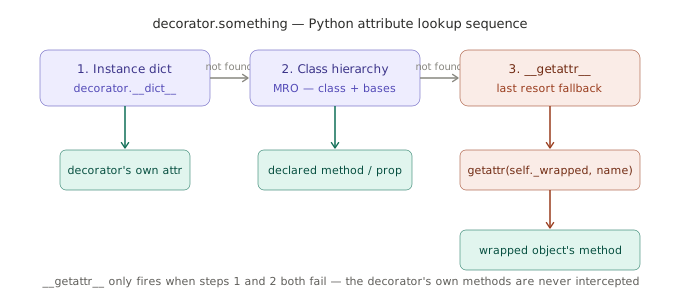
In Python, this is done with __getattr__. The rule Python follows when you access obj.something is:
- Look for
somethingon the object’s own instance dictionary. - Look for
somethingon the class and its bases (the MRO). - If still not found, call
__getattr__("something")if it is defined.
Step 3 is the hook. A transparent decorator defines __getattr__ to pass any unrecognised attribute through to the wrapped object. The decorator intercepts what it cares about, and everything else falls through automatically — no manual proxying needed.
In plain English:
If you ask the decorator for something it does not know about, it asks the wrapped object instead — silently, automatically, for any attribute, method, or property.
3. The __getattr__ solution
class LoggingDecorator(Writer):
    def __init__(self, wrapped: Writer):
        self._wrapped = wrapped

    def write(self, content: str) -> None:
        print(f"LOG: writing {len(content)} chars")
        self._wrapped.write(content)

    def __getattr__(self, name: str):
        return getattr(self._wrapped, name)
That single __getattr__ method replaces all the manual proxying. Now:
writer = LoggingDecorator(ReportWriter())

writer.write("Annual Report")      # handled by LoggingDecorator.write
writer.set_encoding("utf-8")       # forwarded to ReportWriter.set_encoding
writer.get_page_count()            # forwarded to ReportWriter.get_page_count
writer.flush()                     # forwarded to ReportWriter.flush
The decorator is now transparent. Callers do not need to know or care that the object is wrapped.
4. How __getattr__ actually works
It is important to understand precisely when __getattr__ fires — because it does not fire for every attribute access.
Python has two attribute hooks:
| Hook | When it fires |
|---|---|
__getattribute__ |
On every attribute access, no exceptions |
__getattr__ |
Only when normal lookup has failed |
__getattr__ is the fallback of last resort. This means the decorator’s own methods and attributes are never intercepted by it — they are found by normal lookup first. Only attributes the decorator genuinely does not have reach __getattr__.
The lookup sequence for decorator.something:
1. decorator.__dict__           ("something" in instance dict?)
2. type(decorator).__mro__      ("something" on LoggingDecorator or Writer or ABC?)
3. __getattr__("something")     (last resort — forwards to self._wrapped)
This is exactly what you want: the decorator handles what it declares, the wrapped object handles the rest.
There is one subtle trap. __getattr__ fires when accessing self._wrapped fails too — which can happen during __init__ before self._wrapped is set, causing infinite recursion. The safe pattern is to ensure _wrapped is the very first assignment in __init__:
def __init__(self, wrapped):
    self._wrapped = wrapped  # must be first — __getattr__ may fire before this
In practice this is rarely a problem, but worth knowing.
5. A fuller example: the transparent decorator base class
Rather than re-implementing __getattr__ in every decorator, put it in a shared base:
from abc import ABC, abstractmethod


class Writer(ABC):
    @abstractmethod
    def write(self, content: str) -> None:
        pass


class WriterDecorator(Writer):
    def __init__(self, wrapped: Writer):
        self._wrapped = wrapped

    def write(self, content: str) -> None:
        self._wrapped.write(content)

    def __getattr__(self, name: str):
        return getattr(self._wrapped, name)


class LoggingDecorator(WriterDecorator):
    def write(self, content: str) -> None:
        print(f"LOG: writing {len(content)} chars")
        self._wrapped.write(content)


class CompressionDecorator(WriterDecorator):
    def write(self, content: str) -> None:
        compressed = f"[compressed]{content}[/compressed]"
        self._wrapped.write(compressed)
Now LoggingDecorator and CompressionDecorator only declare what they actually change. Everything else on ReportWriter passes through automatically:
class ReportWriter(Writer):
    def write(self, content: str) -> None:
        print(f"Writing: {content}")

    def set_encoding(self, encoding: str) -> None:
        print(f"Encoding set to {encoding}")

    def get_page_count(self) -> int:
        return 12

    def flush(self) -> None:
        print("Flushing")


writer = CompressionDecorator(LoggingDecorator(ReportWriter()))

writer.write("Q4 Report")     # handled by each decorator in turn
writer.set_encoding("utf-8")  # passes through both decorators to ReportWriter
writer.get_page_count()       # passes through both decorators to ReportWriter
writer.flush()                # passes through both decorators to ReportWriter
The two decorators do not know about set_encoding, get_page_count, or flush — and they do not need to. __getattr__ on each layer forwards to the next until it reaches an object that does know.
6. Natural example: a caching layer over a repository
A transparent decorator is particularly valuable when decorating objects with large, stable interfaces — like a repository.
from __future__ import annotations
from dataclasses import dataclass


@dataclass
class Product:
    id: int
    name: str
    price: float


class ProductRepository:
    def find_by_id(self, product_id: int) -> Product | None:
        print(f"DB: querying product {product_id}")
        return Product(id=product_id, name="Widget", price=9.99)

    def find_by_name(self, name: str) -> list[Product]:
        print(f"DB: querying products named '{name}'")
        return []

    def save(self, product: Product) -> None:
        print(f"DB: saving product {product.id}")

    def delete(self, product_id: int) -> None:
        print(f"DB: deleting product {product_id}")

    def find_all(self) -> list[Product]:
        print("DB: fetching all products")
        return []

    def count(self) -> int:
        print("DB: counting products")
        return 42
A caching decorator only cares about find_by_id. Everything else — find_by_name, save, delete, find_all, count — it should leave alone. Without __getattr__, you would need to proxy all six methods. With it:
class CachingRepository:
    def __init__(self, wrapped: ProductRepository):
        self._wrapped = wrapped
        self._cache: dict[int, Product] = {}

    def find_by_id(self, product_id: int) -> Product | None:
        if product_id not in self._cache:
            self._cache[product_id] = self._wrapped.find_by_id(product_id)
        else:
            print(f"CACHE: hit for product {product_id}")
        return self._cache[product_id]

    def __getattr__(self, name: str):
        return getattr(self._wrapped, name)
Usage:
repo = CachingRepository(ProductRepository())

repo.find_by_id(1)              # DB: querying product 1
repo.find_by_id(1)              # CACHE: hit for product 1
repo.find_by_name("Widget")     # forwarded straight to DB
repo.count()                    # forwarded straight to DB
repo.save(Product(2, "Gadget", 19.99))  # forwarded straight to DB
The caching decorator declares one method. The repository’s full interface remains accessible through zero manual proxying.
7. Connection to earlier learned concepts and SOLID
Transparent Decorator vs standard Decorator
Standard Decorator requires the shared interface to cover everything callers might need. Transparent Decorator removes that constraint — the shared interface only needs to cover what decorators intercept. Everything else passes through. Transparent Decorator is a more pragmatic version of the same pattern for real-world objects whose full interface you do not control or do not want to replicate.
Transparent Decorator vs Adapter
An Adapter uses __getattr__-style forwarding too — it wraps an incompatible object and exposes a different interface. The difference is intent:
| Pattern | Intent | Changes the interface? |
|---|---|---|
| Adapter | Translate between two different interfaces | Yes |
| Transparent Decorator | Extend behaviour while preserving the full original interface | No |
If you are forwarding everything and translating nothing, it is a transparent Decorator. If you are renaming methods and reshaping return values, it is an Adapter.
SOLID principles
Single Responsibility Principle — each decorator still does one thing. CachingRepository only caches. It does not need to know about saving, deleting, or counting — those responsibilities remain in ProductRepository and reach callers transparently.
Open/Closed Principle — when ProductRepository gains a new method, zero decorators need updating. The __getattr__ fallback handles new methods automatically. This is a stronger OCP guarantee than the standard Decorator, which would require every decorator to add a forwarding method.
Dependency Inversion Principle — CachingRepository still depends on the abstraction. The __getattr__ fallback uses getattr(self._wrapped, name), which works on any object — not just ProductRepository.
Interface Segregation Principle — the shared interface can remain minimal, covering only what decorators actually need to intercept. Callers who need the full interface get it through the transparent fallback, not through an artificially bloated abstract base class.
8. Example from a popular Python package
Python’s unittest.mock.MagicMock is one of the most widely-used transparent proxy implementations. When you access any attribute on a MagicMock, it does not raise AttributeError — it dynamically creates and returns a new mock for that attribute. This is __getattr__ in action:
from unittest.mock import MagicMock

repo = MagicMock(spec=ProductRepository)

repo.find_by_id(1)        # auto-creates a mock method, returns a mock
repo.count()              # same — no AttributeError
repo.anything_at_all()   # same — fully transparent to any attribute access
A closely related real-world example is SQLAlchemy’s lazy-loading proxies. When you access a relationship attribute on a model instance that has not been loaded yet, SQLAlchemy’s instrumentation intercepts the access via __getattr__-equivalent machinery, fires a database query, and returns the result — all transparently. The caller just accesses order.customer and gets back a Customer object, with no idea that a query happened.
9. When to use and when not to use
Use a transparent decorator when:
| Situation | Why transparent decoration helps |
|---|---|
| The wrapped object has a large interface | Avoids proxying dozens of methods manually |
| You only need to intercept a few methods | __getattr__ handles everything you do not override |
| The wrapped object’s interface changes over time | New methods work automatically with no decorator updates |
| You do not own or control the wrapped class | Cannot make it implement your interface — forward everything else |
| You are decorating third-party objects | Their interface is not yours to define |
Be cautious when:
- Static type checking matters.
__getattr__is invisible to mypy and pyright. The type checker seesLoggingDecorator, which does not declareset_encoding, and will flagwriter.set_encoding(...)as an error even though it works at runtime. You can address this with__getattr__type stubs, but it adds friction. - The interface must be contractually enforced. If callers must only use methods the decorator declares, transparent forwarding is too permissive — it lets anything through.
- Performance is critical. Every forwarded attribute access goes through
__getattr__, which is slower than a direct method call. For tight loops over large datasets this can matter. - The wrapped object has private or internal methods you should not expose. Transparent forwarding exposes everything, including internals. If the wrapped object has methods that are implementation details, forwarding them to callers may create a leaky abstraction.
10. Practical rule of thumb
Ask:
Am I writing forwarding methods that do nothing but call the same method on
self._wrapped?
If yes, delete them and use __getattr__ instead.
Ask:
Is my decorator only intercepting a small subset of the wrapped object’s methods?
If yes, __getattr__ forwarding saves you from proxying everything else.
Ask:
Does the wrapped object’s interface change independently of my decorator?
If yes, transparent decoration means your decorator stays correct automatically when new methods are added.
Ask:
Do I need static type safety for the forwarded methods?
If yes, you will need to add type stubs or consider whether transparent decoration is the right trade-off.
11. Summary and mental model
Type erosion is the cost of standard Decorator: wrapping an object hides everything the shared interface does not declare. Transparent Decorator eliminates that cost by making __getattr__ the forwarding mechanism, so the decorator only needs to declare what it actually changes.
Standard Decorator:
    declare every method you want callers to reach
    anything undeclared is invisible

Transparent Decorator:
    declare only the methods you intercept
    everything else passes through automatically
Mental model — think of a one-way mirror:
Standard Decorator:    an opaque box — only what you cut holes in is visible
Transparent Decorator: a one-way mirror — you see everything on the other side,
                       but you can paint over the parts you want to intercept
In one sentence:
A transparent decorator uses
__getattr__to forward any attribute it does not handle to the wrapped object, so the decorator only needs to declare what it intercepts — not everything the wrapped object knows how to do.