Math Notes
Notes on algebra, probability theory, and linear algebra
Quotient Spaces
0. The guiding question
A subspace $U\subseteq V$ is a collection of directions inside a vector space. Sometimes we want to ignore those directions.
For example, in $\mathbb R^3$, suppose $U$ is the horizontal $xy$-plane. If we decide that horizontal movement does not matter, then two points should be considered equivalent whenever they have the same height. What remains is a one-dimensional idea: the vertical coordinate.
A quotient space formalizes this idea.
The quotient $V/U$ is the vector space obtained from $V$ by declaring all vectors of $U$ to be zero.
The point is subtle: the elements of $V/U$ are not the original vectors of $V$. They are equivalence classes of vectors.
1. Equivalence modulo a subspace
Let $V$ be a vector space over a field $K$, and let $U\subseteq V$ be a subspace.
We define a relation on $V$ by
\[v\sim v'\]if
\[v-v'\in U.\]Equivalently, $v\sim v’$ if there exists some $u\in U$ such that
\[v=v'+u.\]So $v$ and $v’$ are considered the same modulo $U$ if they differ only by a vector from $U$.
This relation is called equivalence modulo $U$, or congruence modulo $U$.
Theorem: $\sim$ is an equivalence relation
The relation $v\sim v’$ defined by $v-v’\in U$ is reflexive, symmetric, and transitive.
Proof idea
Reflexivity holds because
\[v-v=0\in U.\]Symmetry holds because if $v-v’\in U$, then
\[v'-v=-(v-v')\in U.\]Transitivity holds because if $v-v’\in U$ and $v’-v’‘\in U$, then
\[v-v''=(v-v')+(v'-v'')\in U.\]All three steps use exactly the fact that $U$ is a subspace: it contains $0$, is closed under negatives, and is closed under addition.
2. Cosets: the elements of the quotient
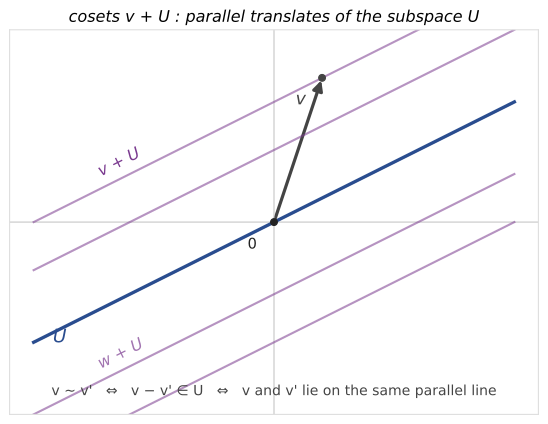
The equivalence class of a vector $v\in V$ is
\[v+U=\{v+u\mid u\in U\}.\]This is called a coset of $U$ in $V$.
Important:
$v+U$ is not one vector. It is a whole subset of $V$.
The quotient space $V/U$ is the set of all such cosets:
\[V/U=\{v+U\mid v\in V\}.\]So an element of $V/U$ is a class of vectors that differ by elements of $U$.
The class of zero is
\[0+U=U.\]Thus the zero vector of the quotient is the whole subspace $U$. This is the precise meaning of saying that $U$ has been collapsed to zero.
3. Operations in the quotient
We define addition and scalar multiplication of cosets by
\[(v+U)+(w+U)=(v+w)+U,\]and
\[\lambda(v+U)=(\lambda v)+U.\]These definitions are natural: to add two classes, choose representatives, add them in $V$, and take the class of the result.
But there is a possible danger. A coset has many representatives. We must check that the result does not depend on which representatives we choose.
Theorem: the operations are well-defined
If
\[v+U=v'+U\]and
\[w+U=w'+U,\]then
\[(v+w)+U=(v'+w')+U.\]Also, for every $\lambda\in K$,
\[(\lambda v)+U=(\lambda v')+U.\]Proof idea
The equality $v+U=v’+U$ means $v-v’\in U$. Similarly, $w-w’\in U$. Therefore
\[(v+w)-(v'+w')=(v-v')+(w-w')\in U.\]So $v+w$ and $v’+w’$ determine the same coset.
For scalar multiplication, if $v-v’\in U$, then
\[\lambda v-\lambda v'=\lambda(v-v')\in U.\]Again, this uses exactly that $U$ is closed under addition and scalar multiplication.
Theorem: $V/U$ is a vector space
With the operations above, $V/U$ is a vector space over $K$.
Proof idea
Once the operations are well-defined, the vector space axioms follow from the corresponding axioms in $V$. For example, associativity of addition in $V/U$ follows because
\[((a+U)+(b+U))+(c+U) =((a+b)+c)+U\]and
\[(a+U)+((b+U)+(c+U)) =(a+(b+c))+U,\]which are equal because addition in $V$ is associative. The other axioms work the same way.
4. The quotient map
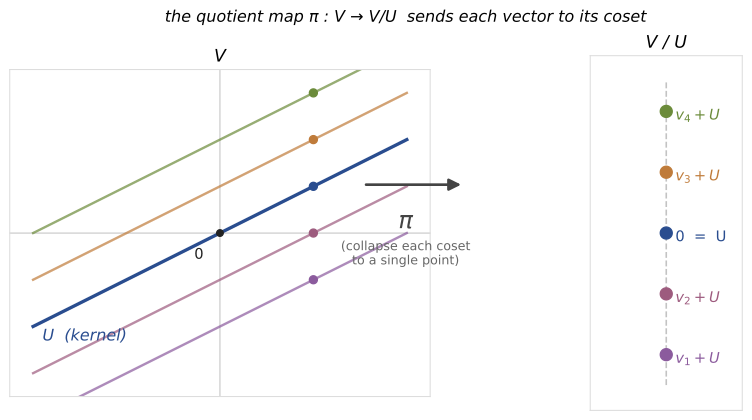
There is a natural map
\[\pi:V\to V/U\]called the quotient map, defined by
\[\pi(v)=v+U.\]It sends each vector to its equivalence class.
This map is linear:
\[\pi(v+w)=(v+w)+U=(v+U)+(w+U)=\pi(v)+\pi(w),\]and
\[\pi(\lambda v)=(\lambda v)+U=\lambda(v+U)=\lambda\pi(v).\]Its kernel is exactly $U$:
\[\ker\pi=U.\]Indeed,
\[\pi(v)=0_{V/U}\]means
\[v+U=U,\]which happens exactly when $v\in U$.
This gives another useful interpretation:
The quotient map is the linear map that kills precisely the subspace $U$.
5. Geometric example: horizontal planes
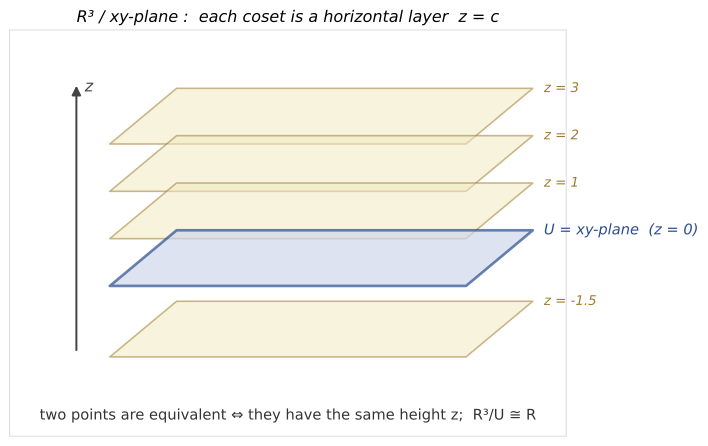
Let
\[V=\mathbb R^3\]and let
\[U=\{(x,y,0)\mid x,y\in\mathbb R\},\]the $xy$-plane.
Two vectors $(x,y,z)$ and $(x’,y’,z’)$ are equivalent modulo $U$ when
\[(x,y,z)-(x',y',z')=(x-x',y-y',z-z')\]lies in $U$. This happens exactly when
\[z=z'.\]So the cosets are horizontal planes
\[z=c.\]The quotient $\mathbb R^3/U$ is the space of horizontal layers. Each layer is determined by one number, its height $c$. Therefore
\[\mathbb R^3/U\cong \mathbb R.\]This example captures the main intuition:
Quotienting by $U$ means that motion inside $U$ no longer matters.
Horizontal displacement is forgotten. Only vertical height remains.
6. Example: quotienting a function space by invisible data
Let $X$ be a set, let $Y\subseteq X$, and let
\[V=\mathcal F(X,K)\]be the vector space of all functions $X\to K$.
Define
\[I(Y)=\{g:X\to K\mid g(y)=0\text{ for all }y\in Y\}.\]This is a subspace of $V$: it consists of all functions that vanish on $Y$.
Now consider the quotient
\[\mathcal F(X,K)/I(Y).\]Two functions $f,f’\in\mathcal F(X,K)$ define the same coset if
\[f-f'\in I(Y),\]which means
\[f(y)=f'(y)\]for every $y\in Y$.
So the quotient forgets everything outside $Y$ and remembers only the values on $Y$.
There is a natural isomorphism
\[\mathcal F(X,K)/I(Y)\cong \mathcal F(Y,K)\]given by
\[f+I(Y)\mapsto f|_Y.\]Proof idea
The map is well-defined because if $f-f’$ vanishes on $Y$, then $f$ and $f’$ have the same restriction to $Y$. It is injective because if two functions have the same restriction to $Y$, then their difference vanishes on $Y$. It is surjective because any function on $Y$ can be extended to some function on $X$. Linearity is inherited from pointwise operations.
This example is conceptually important: quotienting is not only a geometric operation. It is a way of keeping some information and declaring other information irrelevant.
7. Dimension of a quotient
Now assume $V$ is finite-dimensional and $U\subseteq V$.
Theorem: dimension formula for quotients
\[\dim(V/U)=\dim V-\dim U.\]Proof idea
Choose a basis of $U$, say
\[(e_1,\dots,e_m),\]and extend it to a basis of $V$:
\[(e_1,\dots,e_m,e_{m+1},\dots,e_n).\]The vectors $e_1, \dots,e_m$ disappear in the quotient because they lie in $U$:
\[e_i+U=U=0_{V/U}\]for $1\leq i\leq m$.
The surviving classes
\[e_{m+1}+U, \dots, e_n+U\]form a basis of $V/U$.
They span because every vector $v\in V$ can be written as
\[v=a_1e_1+\cdots+a_me_m+a_{m+1}e_{m+1}+\cdots+a_ne_n,\]and in the quotient the first $m$ terms vanish:
\[v+U=a_{m+1}(e_{m+1}+U)+\cdots+a_n(e_n+U).\]They are linearly independent because a relation
\[a_{m+1}(e_{m+1}+U)+\cdots+a_n(e_n+U)=U\]means
\[a_{m+1}e_{m+1}+\cdots+a_ne_n\in U.\]But the only linear combination of $e_{m+1},\dots,e_n$ that lies in $U=\langle e_1,\dots,e_m\rangle$ is the zero combination, because the full list is a basis of $V$. Thus all coefficients are zero.
So $V/U$ has $n-m$ basis vectors, and
\[\dim(V/U)=n-m=\dim V-\dim U.\]8. Codimension
The codimension of $U$ in $V$ is defined by
\[\operatorname{codim}_V U=\dim(V/U).\]If $V$ is finite-dimensional, then
\[\operatorname{codim}_V U=\dim V-\dim U.\]The dimension of $U$ counts how many independent directions lie inside $U$. The codimension counts how many independent directions remain after $U$ has been collapsed.
Examples:
\[\operatorname{codim}_{\mathbb R^3}(\text{plane through }0)=1.\]A plane in $\mathbb R^3$ leaves one independent transverse direction.
\[\operatorname{codim}_{\mathbb R^3}(\text{line through }0)=2.\]A line in $\mathbb R^3$ leaves two independent transverse directions.
\[\operatorname{codim}_V V=0.\]If we collapse all of $V$, nothing remains.
\[\operatorname{codim}_V \{0\}=\dim V.\]If we collapse only zero, the whole space remains.
9. Quotients and complements
A quotient space is abstract: its elements are cosets. But sometimes we can choose a concrete representative from each coset.
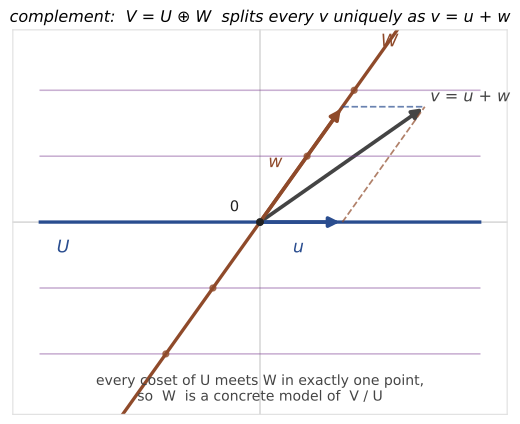
Suppose $W\subseteq V$ is a subspace such that
\[V=U\oplus W.\]This means every vector $v\in V$ can be written uniquely as
\[v=u+w,\]where $u\in U$ and $w\in W$.
Then $W$ gives one representative of each quotient class.
Theorem: a complement represents the quotient
If
\[V=U\oplus W,\]then
\[V/U\cong W.\]More precisely, the map
\[\varphi:W\to V/U, \qquad \varphi(w)=w+U\]is an isomorphism.
Proof idea
The map is linear because quotient operations are defined using representatives:
\[\varphi(w_1+w_2)=(w_1+w_2)+U=(w_1+U)+(w_2+U).\]It is injective because if
\[w+U=w'+U,\]then $w-w’\in U$. But $w-w’\in W$ too. Since $V=U\oplus W$, we have
\[U\cap W=\{0\}.\]Thus $w-w’=0$, so $w=w’$.
It is surjective because every class $v+U$ has a representative in $W$. Indeed, write
\[v=u+w.\]Then
\[v+U=(u+w)+U=w+U.\]The $U$-part disappears in the quotient.
So each coset meets $W$ in exactly one point.
10. Quotient versus complement
The theorem above does not say that $V/U$ is literally equal to $W$.
They are different kinds of objects:
- $W$ consists of vectors of $V$;
- $V/U$ consists of cosets of $U$.
The theorem says that once a complement $W$ has been chosen, $W$ gives a concrete model of the quotient.
The difference matters because complements are not unique.
For example, in $\mathbb R^2$, let
\[U=\langle (1,0)\rangle,\]the $x$-axis. The $y$-axis is a complement, but so is the line
\[\langle(1,1)\rangle.\]In fact, every line through the origin except the $x$-axis is a complement of $U$.
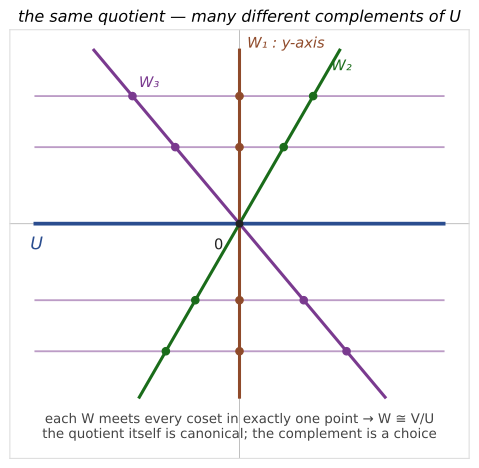
Each complement is isomorphic to $\mathbb R^2/U$, but no one of them is forced by $U$ alone.
The quotient $V/U$, however, is canonical: it is determined only by $V$ and $U$.
So the correct mental picture is:
\[\boxed{\text{A quotient is canonical.}}\] \[\boxed{\text{A complement is a choice of representatives.}}\]11. Common confusions
Confusion 1: $V/U$ consists of vectors outside $U$
No. The quotient consists of cosets $v+U$, not individual vectors. A vector $v$ is only a representative of the coset $v+U$.
Confusion 2: the zero of $V/U$ is the vector $0$
Not exactly. The zero element of $V/U$ is the coset
\[0+U=U.\]So the whole subspace $U$ becomes zero.
Confusion 3: quotienting removes vectors
It is better to say that quotienting identifies vectors. Vectors that differ by an element of $U$ become the same element of $V/U$.
Confusion 4: a complement is the same thing as the quotient
A complement $W$ is a concrete subspace inside $V$. The quotient $V/U$ is a space of cosets. If $V=U\oplus W$, then $W\cong V/U$, but the isomorphism depends on the choice of $W$.
12. Summary
The quotient $V/U$ is built by declaring two vectors equivalent if they differ by an element of $U$:
\[v\sim v' \quad\Longleftrightarrow\quad v-v'\in U.\]Its elements are cosets
\[v+U.\]The operations are
\[(v+U)+(w+U)=(v+w)+U,\]and
\[\lambda(v+U)=(\lambda v)+U.\]The zero element is
\[U.\]If $V$ is finite-dimensional, then
\[\dim(V/U)=\dim V-\dim U.\]This number is the codimension of $U$ in $V$.
If $W$ is a complement of $U$, meaning
\[V=U\oplus W,\]then
\[V/U\cong W.\]The quotient is the abstract space of directions left after ignoring $U$. A complement is a concrete choice of one representative for each quotient class.